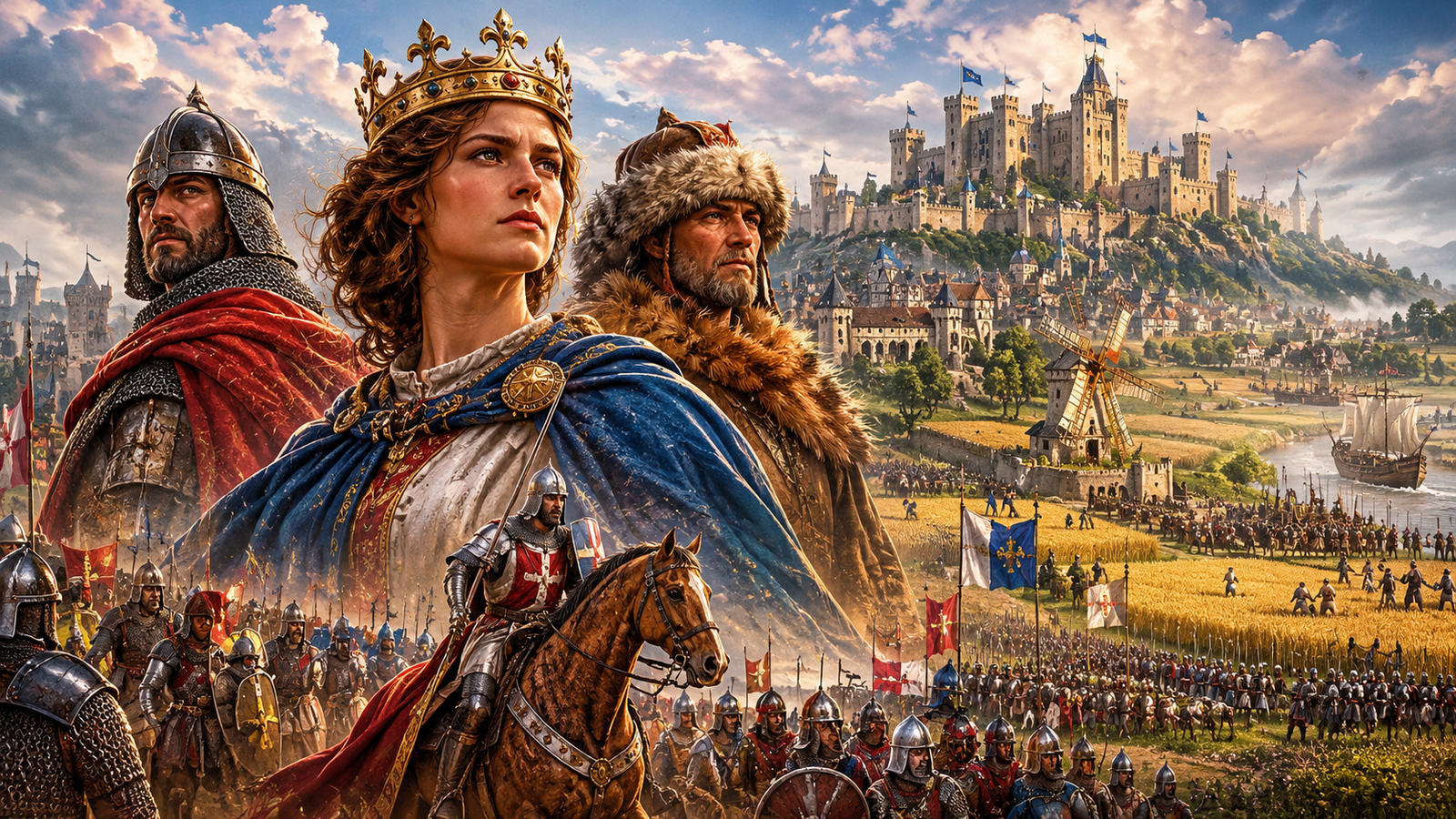
Age of Empires is a legendary real-time strategy gaming franchise that allows players to build civilizations, gather resources, develop armies, and compete for control of the world. From managing small settlements to commanding powerful empires, the series combines historical themes with tactical decision-making. Its appeal comes from the freedom to choose different civilizations, explore new strategies, and experience historical campaigns or competitive multiplayer battles.
Age of Empires: Game Overview
The first Age of Empires launched in 1997, developed by Ensemble Studios and published by Microsoft. It introduced players to a historical strategy experience built around civilization development, resource management, technological progress, and warfare.
The series later expanded with sequels, remastered editions, and additional content exploring different historical periods and cultures.
Rather than focusing on a single hero or linear storyline, most mainline Age of Empires games let players control an entire civilization. Every decision, from gathering food to building an army, contributes to the development and survival of the empire.
Quick Facts About Age of Empires
| Detail | Information |
|---|---|
| Game franchise | Age of Empires |
| Genre | Real-time strategy (RTS) |
| Original release | 1997 |
| Original developer | Ensemble Studios |
| Original publisher | Microsoft |
| Modern franchise studio | World’s Edge |
| Main gameplay | Civilization building, resource management, warfare |
| Setting | Different historical periods |
| Play styles | Single-player, campaigns, skirmishes, and multiplayer, depending on the title |
| Latest major Age of Empires IV expansion | Raiders of the North |
| Expansion release date | October 29, 2026 |
| Suitable for | Strategy fans, history enthusiasts, and competitive players |
Gameplay and Main Features
The central gameplay loop of Age of Empires revolves around building an economy, expanding a settlement, researching technologies, and defending territory. Players must balance military strength with economic development because an army cannot remain effective without a reliable supply of resources.
Resource Management
Resources are essential to almost every major decision. Depending on the game, players gather food, wood, gold, stone, or other resources to construct buildings, train units, and research upgrades.
Villagers and other worker units perform important economic tasks. Assigning them efficiently helps players develop their settlements without leaving their economies vulnerable to enemy attacks.
A strong economy supports faster expansion, while poor resource management can leave a civilization unable to replace lost troops or complete important buildings.
Building and Expanding an Empire
Players begin with limited infrastructure and gradually develop a functioning civilization. They construct houses, production buildings, defensive structures, and other facilities that support population growth and military preparation.
Expansion also requires map awareness. Controlling valuable resources, securing important routes, and protecting exposed settlements can create advantages before the main battle begins.
Research and Technological Progress
Advancing through historical ages is one of the franchise’s defining mechanics. New technologies and improved units can change the balance of power, giving players access to stronger military options and more developed economies.
In Age of Empires IV, the advancement system also includes civilization-specific landmarks. Choosing which landmark to construct can influence a player’s economic or military strategy.
Military Combat
Combat involves more than producing the largest possible army. Unit composition, positioning, timing, terrain, and resource availability all affect the outcome of a battle.
Players can field infantry, cavalry, ranged troops, siege weapons, and naval forces where supported by the selected civilization and game. Different units serve different purposes, making it important to understand their strengths and weaknesses.
Civilizations and Historical Settings
One of the biggest attractions of Age of Empires is its range of historical civilizations. The available choices depend on the individual game and its expansions.
Age of Empires IV, for example, includes civilizations such as the English, Chinese, French, Mongols, Malians, Ottomans, and Rus, alongside additional choices introduced through expansions. Each civilization has distinctive mechanics, units, and strategic possibilities.
Here are three important ways civilizations shape gameplay:
- Unique strengths: Some civilizations emphasize economic development, while others offer particular military advantages.
- Different strategies: A civilization’s available units and technologies can influence how quickly players expand or attack.
- Historical variety: Different architectural styles, campaigns, and cultural settings make the games feel distinct.
Choosing a civilization that matches your preferred play style can make learning the game easier and help you develop a more consistent strategy.
Game Modes and Mechanics
The available modes differ across the franchise, but several familiar formats appear in its major entries.
Campaign Mode
Campaigns present historical events through connected missions and objectives. Players may command armies associated with historical leaders, defend settlements, capture territory, or overcome difficult military situations.
In Age of Empires IV, the original campaigns include the Norman Campaign, the Hundred Years’ War, the Mongol Empire, and the Rise of Moscow. These campaigns combine historical settings with playable missions and narrative elements.
Campaign mode is a good starting point for players who prefer structured objectives instead of immediately competing against experienced opponents.
Skirmish Mode
Skirmish matches allow players to face computer-controlled opponents on selected maps. Depending on the game, players can adjust settings and choose civilizations to practise different strategies.
This mode is particularly useful for learning resource management, improving defensive planning, and experimenting with military compositions before entering competitive matches.
Multiplayer
Multiplayer introduces the unpredictability of human opponents. Players may need to respond to early attacks, unexpected economic strategies, or opponents who control the map more effectively.
Ranked matches, casual games, and cooperative options vary by title. In supported games, multiplayer offers considerable replay value because each opponent may approach the same situation differently.
The Crucible in Age of Empires IV
The Crucible is an additional single-player mode introduced with the Dynasties of the East expansion. It uses roguelite-style challenges, variable objectives, enemy encounters, and upgrades to create a different experience from traditional skirmishes.
The mode was subsequently expanded with new missions in Raiders of the North, including the option to play solo or in two-player co-op.
Story and Historical Campaigns
Age of Empires is not a conventional story-driven franchise with one continuous protagonist. Its historical campaigns instead explore different leaders, conflicts, and civilizations across separate games.
In Age of Empires IV, the Norman Campaign follows the struggle surrounding William of Normandy and the conquest of England. Other campaigns explore the Hundred Years’ War, the rise of Moscow, and the expansion of the Mongol Empire.
The Yue Fei’s Legacy expansion adds another historical perspective. Released on May 7, 2026, it introduces an eight-mission campaign centred on the Song Dynasty general Yue Fei and the conflict with the Jin Dynasty. It also adds the Jin Dynasty as a playable civilization.
Although the games draw on real historical events, they are designed for entertainment. Specific mission events, character portrayals, and gameplay mechanics should not automatically be treated as exact historical records.
Platforms and System Requirements
Age of Empires availability depends on the specific edition.
Age of Empires IV: Anniversary Edition is available on PC and Xbox consoles, and it launched on PlayStation 5 in November 2025. Age of Empires II: Definitive Edition also expanded to PlayStation 5 in 2025 and arrived on macOS through Steam in May 2026.
Before purchasing a particular game, check its supported platforms and edition requirements. Do not assume that every franchise entry is available on every console or computer operating system.
PC System Requirements
There is no single system-requirement list for the entire franchise. The original game, Definitive Editions, and modern entries have different hardware needs.
For a modern release such as Age of Empires IV, players should check the current minimum and recommended specifications for the edition they intend to install. Important considerations include:
- Operating system compatibility
- Processor and graphics hardware
- Available memory
- Storage space
- Graphics driver compatibility
- Internet access for online features and updates
The exact requirements depend on the selected version, so older specifications should not be used to judge whether a modern release will run well.
Latest Age of Empires Updates in 2026
The franchise remains active, with expansions, patches, and platform releases continuing to add content.
Raiders of the North — October 29, 2026
The latest major Age of Empires IV expansion, Raiders of the North, introduced two playable civilizations: the Vikings and the Scots. The expansion adds distinctive units, buildings, mechanics, music, and other civilization-specific content.
It also introduces Scottish Heathland and Tundra Summer biomes and expands The Crucible with four missions that can be played solo or in two-player co-op.
November 2026 Update
The official Age of Empires IV update published on November 3, 2026, included gameplay improvements, balance changes, and other adjustments connected to the game’s ongoing development.
A subsequent update dated November 12 addressed issues involving co-op Crucible matches, resource-generation exploits, and other cheating methods. These changes demonstrate that ongoing support includes both new content and maintenance of competitive fairness.
Continued Expansion Across the Franchise
Other recent developments include Yue Fei’s Legacy for Age of Empires IV and additional content for Age of Empires II: Definitive Edition. The franchise has also continued to broaden its platform availability, giving more players ways to experience its strategy games.
Tips and Strategies for Beginners
Age of Empires can feel demanding at first because players must manage an economy and a military simultaneously. These practical habits provide a useful foundation.
1. Keep Your Economy Active
Assign workers to gather the resources you need for your current strategy. Avoid leaving available workers idle for long periods, and maintain enough food and other resources to support population growth and military production.
2. Learn the Controls and Hotkeys
Familiarity with common commands makes it easier to manage workers, select buildings, and respond to attacks. Practise essential controls before moving into more demanding multiplayer matches.
3. Scout the Map Early
Exploration helps reveal resources, terrain, enemy positions, and possible routes for expansion. Information can prevent costly mistakes and help you decide whether to defend, expand, or attack.
4. Build a Balanced Army
Producing only one type of unit can leave your forces vulnerable to counters. Learn how different units interact, and adapt your army to the opponent rather than relying on the same composition in every match.
5. Protect Your Workers
Workers are essential to economic development. Defending them from raids helps preserve your ability to gather resources, replace lost troops, and continue building.
6. Understand Your Civilization
Read the civilization’s bonuses, unique units, and available technologies. Developing a strategy around those strengths is often more effective than copying a tactic designed for another civilization.
7. Practise Before Playing Ranked
Campaigns, tutorials, and skirmishes provide opportunities to learn at a comfortable pace. Once you understand the basic mechanics, multiplayer becomes easier to approach with a clear plan.
What Makes Age of Empires Interesting?
The franchise stands out because it combines several different types of decision-making in a single experience.
Economic management: Players must decide how to distribute workers and resources while preparing for future needs.
Military tactics: Successful battles depend on unit selection, positioning, timing, and adaptation.
Historical variety: Different periods and civilizations provide distinct settings, campaigns, and gameplay mechanics.
Replayability: Maps, opponents, civilization choices, and strategic decisions can produce very different matches.
Accessibility with depth: Beginners can learn through structured campaigns and tutorials, while experienced players can spend considerable time refining competitive strategies.
The balance between immediate survival and long-term development is central to the franchise. A player who builds a powerful economy may gain a lasting advantage, but only if they can defend it. Likewise, an aggressive military strategy may secure early victories but become unsustainable without sufficient resources.
Is Age of Empires Worth Playing in 2026?
Age of Empires remains a strong choice for players who enjoy strategy, historical settings, and games that reward planning rather than reflexes alone.
For newcomers interested in modern visuals and historical campaigns, Age of Empires IV: Anniversary Edition offers a contemporary entry point, with campaigns, civilizations, and multiplayer options. Its recent expansions also provide additional ways to play.
Players who prefer the classic gameplay style may want to explore Age of Empires II: Definitive Edition, which continues to receive content and platform support. The best starting point depends on whether you prefer older mechanics, modern presentation, campaign storytelling, or competitive multiplayer.
Before choosing an edition, consider your preferred platform, budget, and interest in expansions. Additional civilizations and content may require separate purchases, depending on the game and edition.
Final Thoughts
Age of Empires has maintained its appeal by turning the growth and survival of civilizations into an engaging strategy experience. Its combination of resource management, technological advancement, military planning, and historical campaigns offers something for both casual players and competitive enthusiasts.
The franchise’s continued development in 2026 shows that it is more than a nostalgic classic. With new civilizations, expansions, patches, and broader platform availability, Age of Empires continues to give players fresh reasons to build an empire, rethink their tactics, and return for another battle.